Search
Three Common Office Problems Solved
Reimagining workspaces to improve wellbeing and productivity
We examine the floorplans of ineffective spaces and easily improve them to become adaptable people-centred offices, without requiring complex and costly construction work.
Problem 1: The overcrowded open-plan space
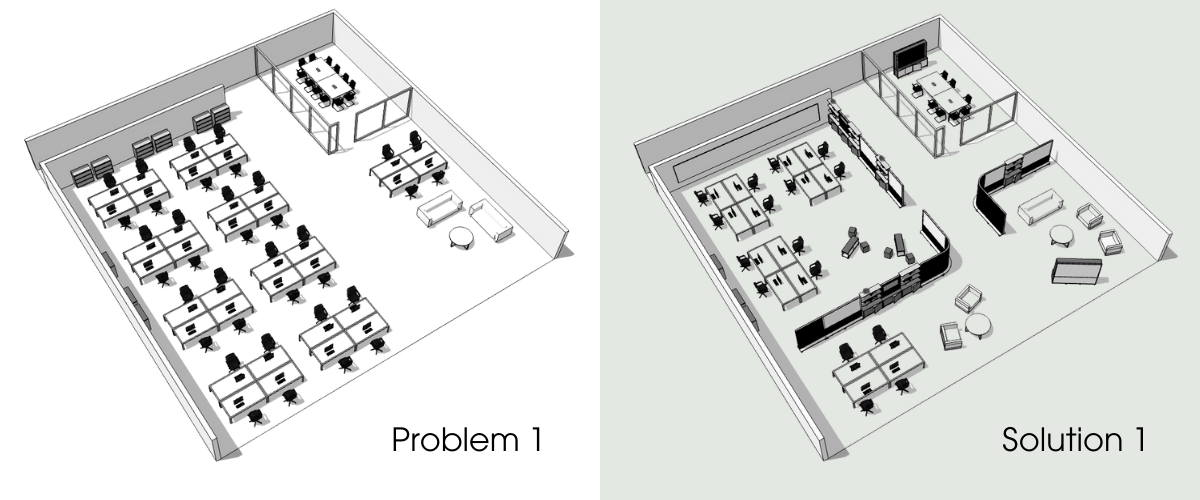
This workplace has been originally designed as a busy, full-occupancy office. It’s a noisy environment, with no privacy for staff and little opportunity for collaboration beyond a formal-style meeting room.
The solution: the shift towards flexible/remote working provides an opportunity to reduce desking in favour of a number of breakout spaces for collaboration and fresh focus
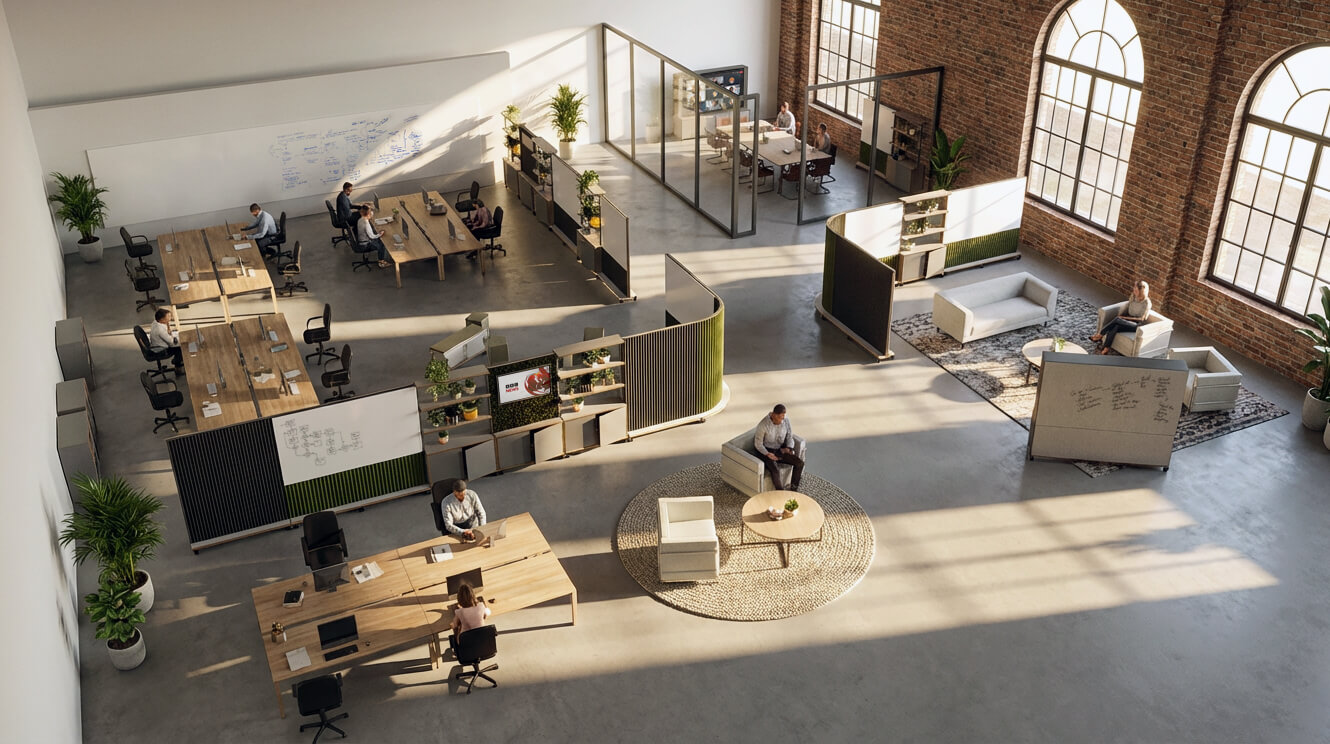
Adding partitioning makes all the difference to this office, breaking up a large area into smaller, more private working spaces. Staff can choose from quiet, focussed areas with simple seating to fully equipped collaboration zones, and this choice/autonomy is known to increase motivation, satisfaction and engagement2. AV screens are available throughout the office to facilitate connection and collaboration with remote colleagues.
An unused wall at the rear of the office is transformed into a perfect-fit magnetic whiteboard allowing team members to note ideas, remind themselves of tasks and display messages. For more formal conversations, or those of a private or confidential nature, the enclosed meeting room is still available, modernised with the addition of a mobile media wall.
Problem 2: The unappealing collaboration space
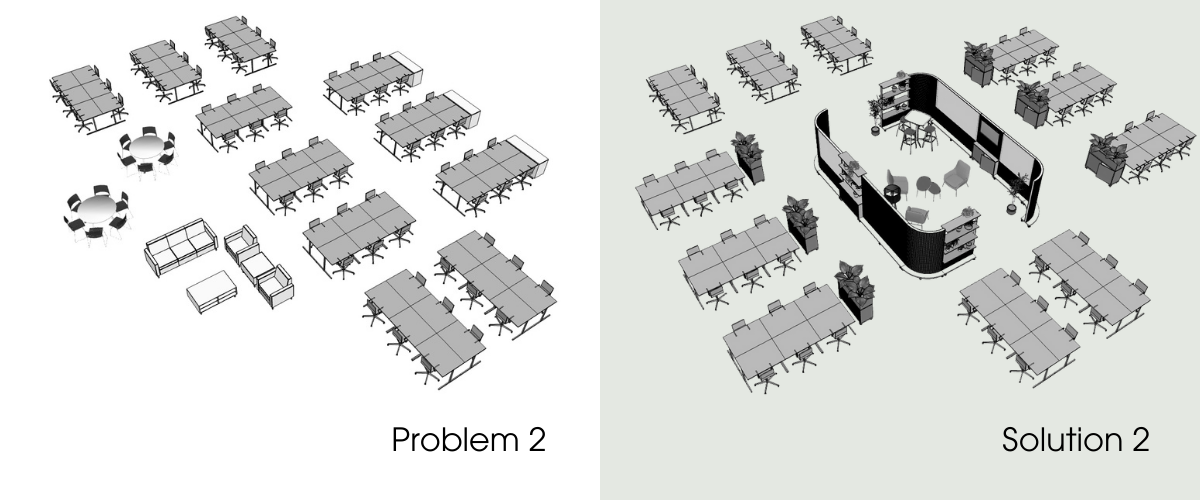
If spaces are functionally useful but undesirable, employees will not use them3. Here’s the perfect example of that – a large office with a breakout space that people are probably avoiding. Although it technically fulfils the function of a meeting space, the low quality seating and lack of privacy make it neither comfortable nor inviting. It is also a distance from the furthest desks, making it somewhat inaccessible.
The solution: adding soft furnishings, privacy and practical but aesthetic dividers makes the space feel private, useable and welcoming
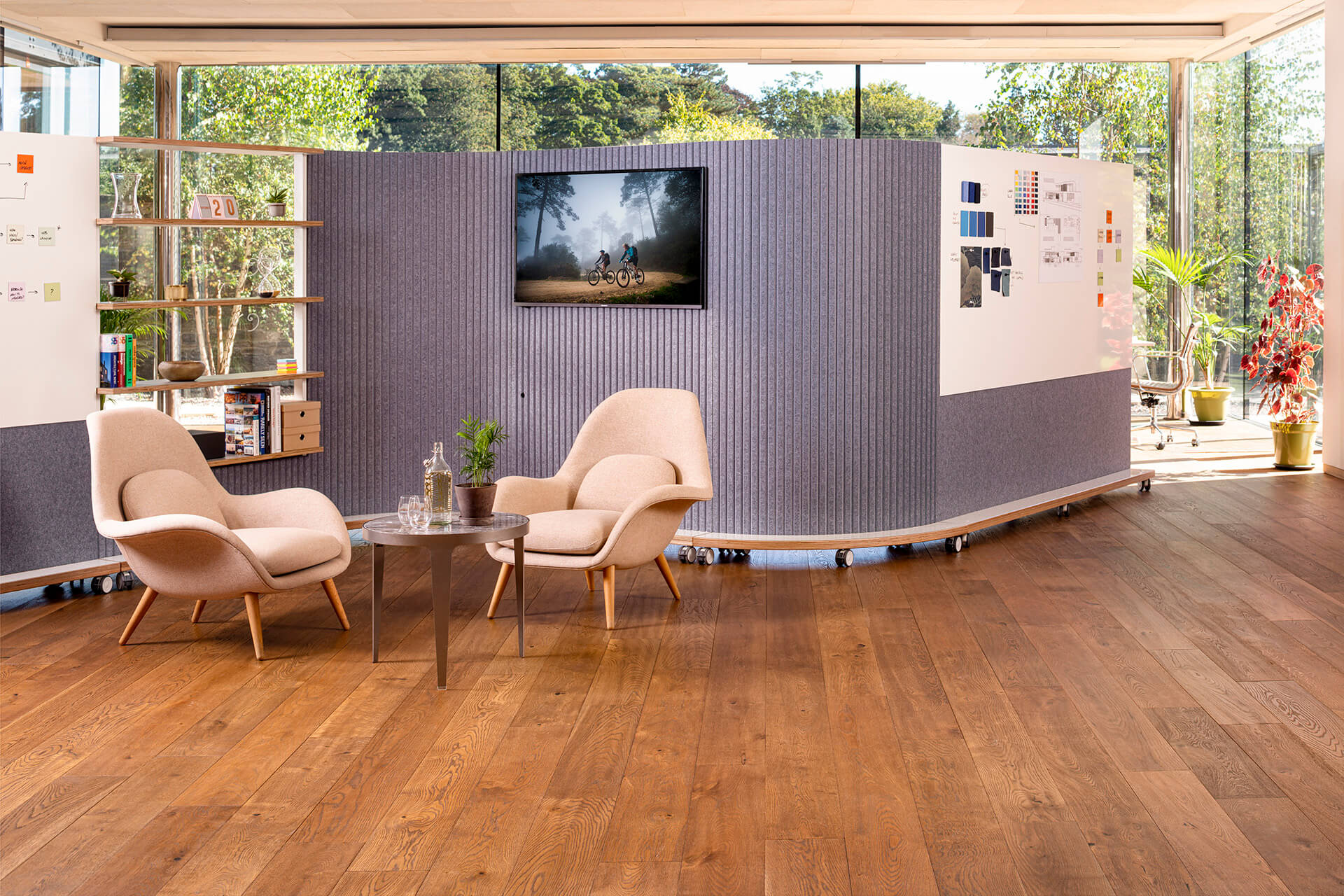
This breakout space works. Centrally positioned, it is a short distance from all desking making it accessible for everyone. Acoustic panels help to soften sound both reducing disruption and increasing privacy, while additional features such as whiteboards and an AV screen support collaboration. The soft furnishings make this an appealing space to spend time in, encouraging regular use. Since the furniture is mobile, staff also have the option to configure it to best suit their needs; it can be a large, open space or sectioned off to accommodate multiple meetings at the same time.
Problem 3: The obstructive dividing wall
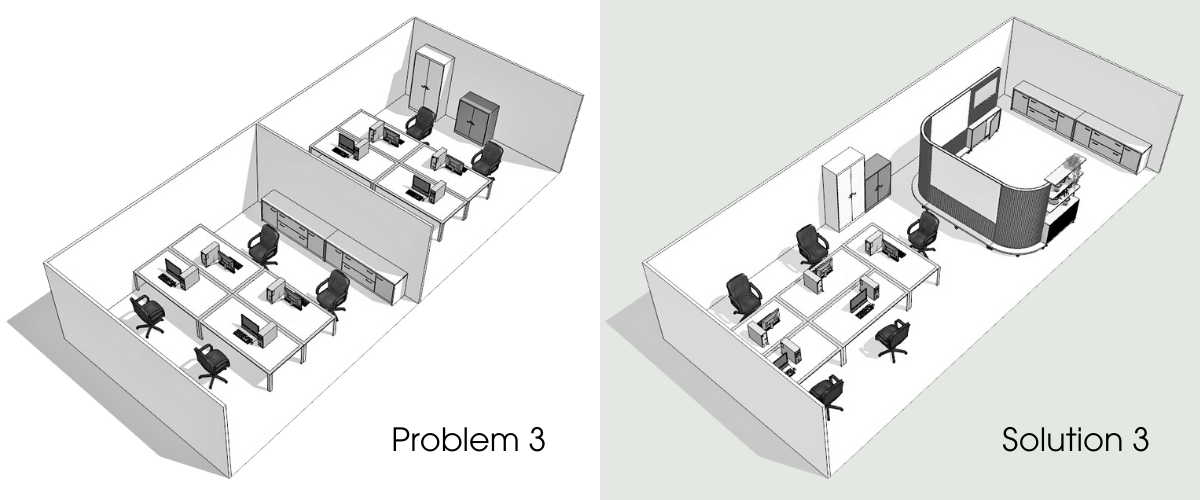
In this workspace, the dividing wall is a mental as well as a physical barrier, requiring more ‘activation energy’ to relocate the team to a collaboration area. It’s more likely that they’ll chat at their desks, which in turn means their work will be less productive – at some point they’ll become distracted from the conversation by surrounding noise/events, or seeing an email pop up in front of them.
The solution: a modern, productive open-plan layout, encouraging idea generation and high-quality thinking
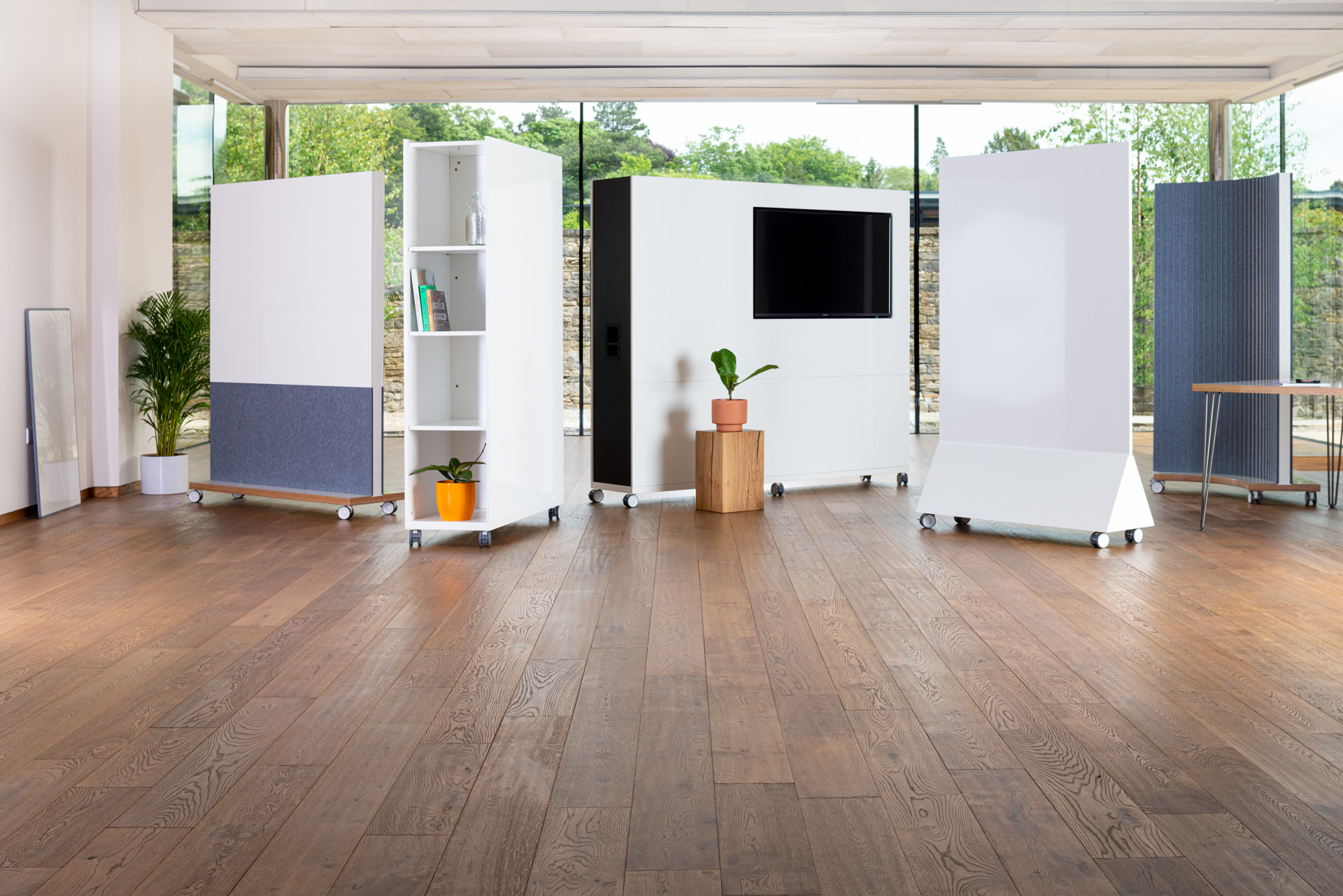
Reinventing this underperforming space creates a desk bank for focussed work and an inviting, easy to access breakout area for the team to refresh focus and collaborate. The removal of the dividing wall (easily replaceable if required) creates a feeling of space while freestanding dividers offer function as well as practicality with the inclusion of whiteboard surfaces, a TV screen and storage. The dividing walls are all double sided. This means there’s now a whiteboard surface available to those in the desk area, maximising space efficiency and providing the team with somewhere to note any reminders or areas of focus.

The power of partitioning
Across all three examples, freestanding partitioning makes all the difference, enabling offices to move from underperforming static spaces to agile, team-centred workspaces. ThinkingWall defines each space without costly and disruptive building works and provides a practical solution that will improve engagement, wellbeing and performance.
Learn more about ThinkingWall.
References
Got any questions?
Find out more